Traditional Dances of the Mangar Community
Exploring the sacred rhythms, theatrical performances, and rich cultural legacy of Mangar folk traditions.
Kauraha (कौराहा)
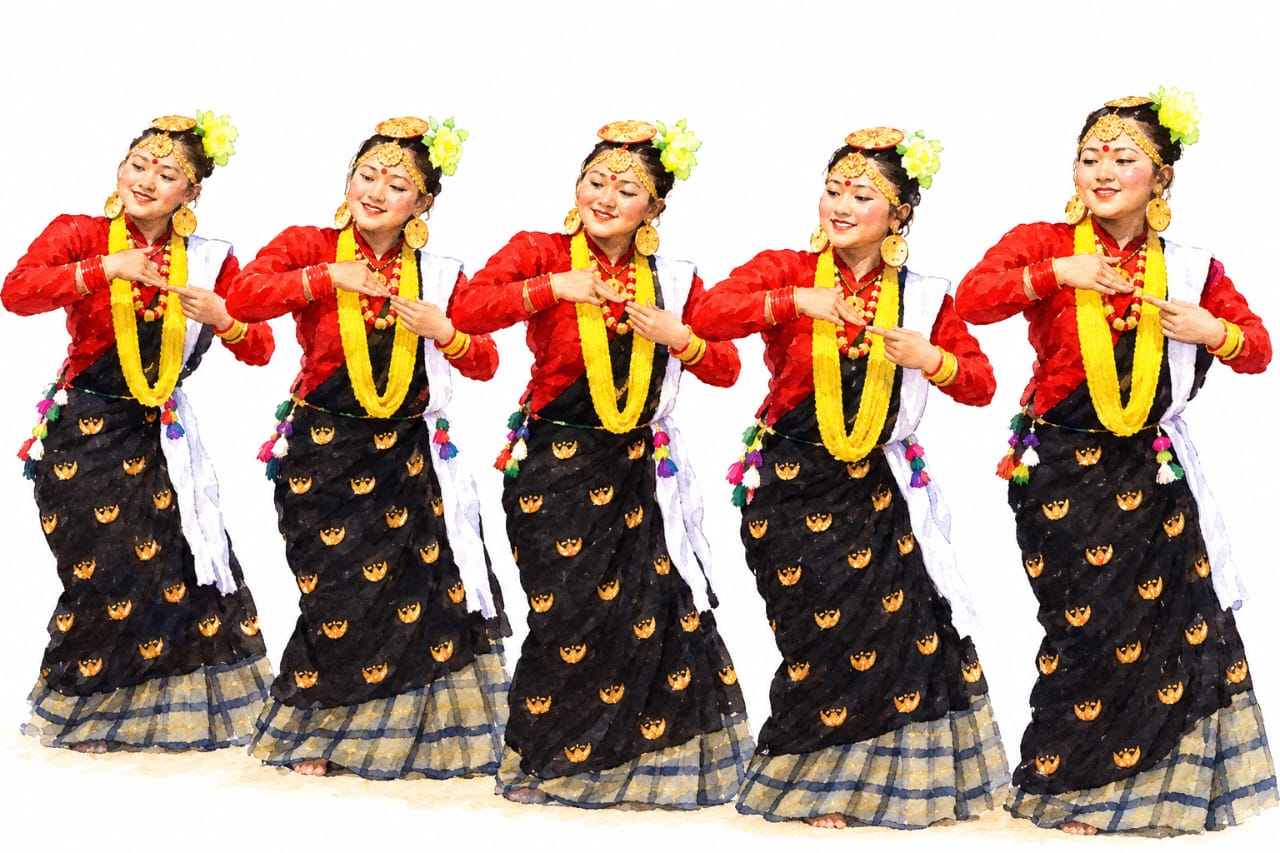
Kauraha is an indigenous traditional dance of the Mangar community, characterised by lively movements, a fast-paced rhythm, and a distinctive circular group formation. The rhythm is primarily maintained by the Khaijadi, a traditional percussion instrument that guides the dancers and keeps the performance in harmony.
The origin of the name Kauraha is traditionally associated with the Mangar expression “Kanraha,” meaning “we have arrived.” It is believed that young Mangar men and women used to announce their arrival at village gatherings, weddings, fairs, and other celebrations by calling out Kanraha. This expression gradually became associated with the dance and its songs. Traditionally, the opening verses were sung in the Mangar language, beginning with the well-known refrain “Kanraha Bhanjiko Jherman le Mhale? Naku Maya Kankhatale.”
A distinctive feature of Kauraha is the repetition of verses, which creates a continuous rhythmic flow and adds energy to the performance. The dance usually begins at a slower pace and gradually develops into faster and more intricate movements, with the hands, feet, and body moving in close coordination with the rhythm.
The songs serve purposes beyond entertainment. They can express self-introduction, enquire about the well-being of others, and convey personal feelings. Traditionally, Kauraha also served as an indirect form of communication between Sali and Bhena (Solti and Soltini). When direct communication was difficult, young people could convey their emotions and messages through the songs.
Traditionally, the number of female dancers in Kauraha is required to be odd, and participation among women was traditionally restricted to unmarried women. Men, however, may participate regardless of marital status and are expected to carry and play the Khaijadi during the performance.
Ghatu (घाँटु)
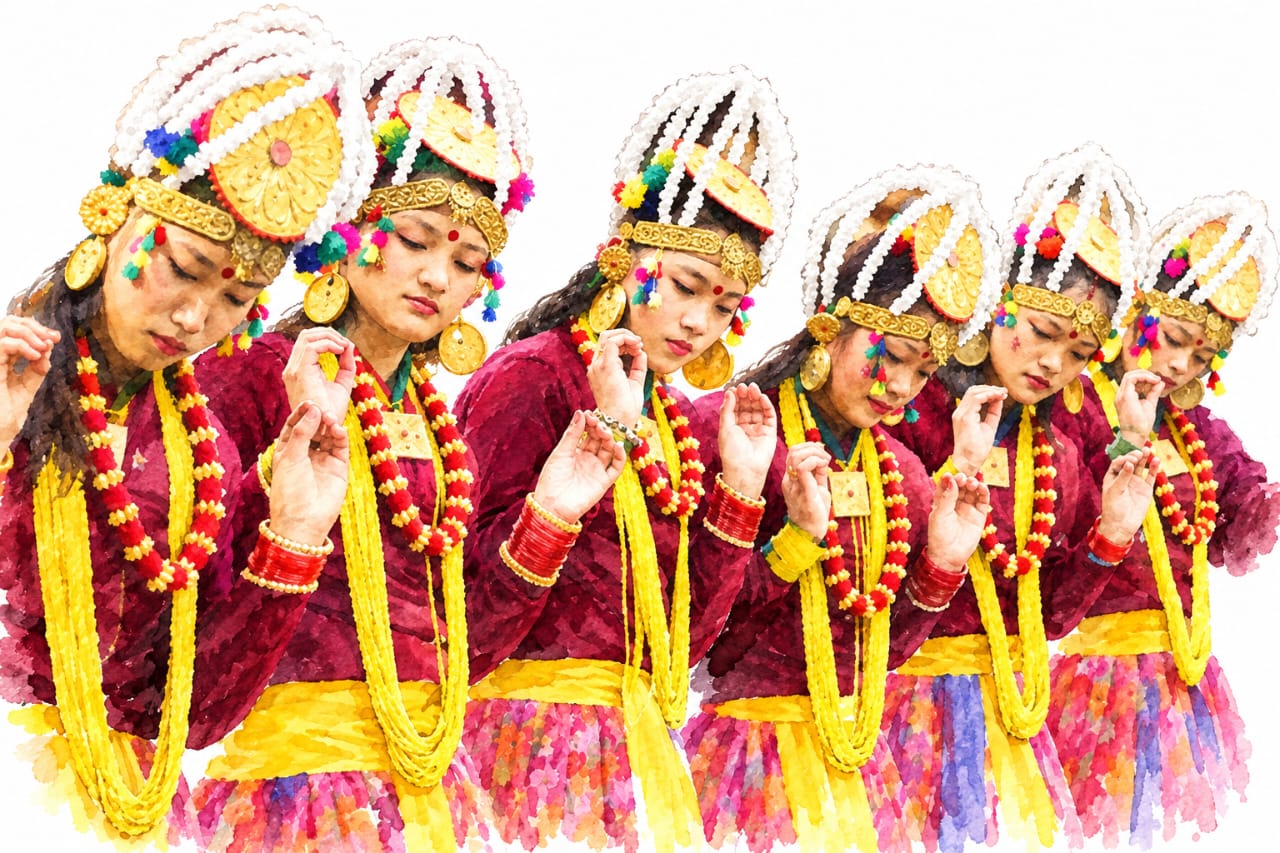
Ghatu is one of the most significant cultural traditions of the Mangar community, embodying elements of history, spirituality, ritual, and social values. It is not merely a form of entertainment, but a living cultural practice that carries the community’s collective memory and identity.
Ghatu is performed only on specific occasions, with the timing, manner, and form of the performance governed by established traditions. Its preparation involves a number of rules and rituals preserved and transmitted orally from one generation to another. The dance brings together song, rhythm, graceful movements, and ceremonial practices, making it a deeply spiritual and cultural journey.
The selection of the young girls who perform Ghatu also carries considerable religious and cultural significance. Traditionally, this selection takes place on Shri Panchami, marking the beginning of spring and symbolising knowledge, purity, and spiritual power. The selection is accompanied by specific worship and ritual practices, and traditionally prescribed physical and religious criteria are observed in choosing the performers.
During the selection ceremony, the participating girls sing traditional Ghatu songs. It is believed that some girls may enter a heightened or trance-like state while singing and dancing, becoming deeply absorbed in the spiritual experience. Such an experience is traditionally interpreted as a sign of divine grace or the blessing of a deity. Girls who are recognised through this ritual process are traditionally referred to as Ghatuni or Ghatusari and are granted the honour and responsibility of performing Ghatu.
Through its ritual discipline, sacred songs, graceful movements, spiritual practices, and oral transmission, Ghatu represents an important repository of Mangar spirituality and cultural heritage.
Sorathi (सोरठी)
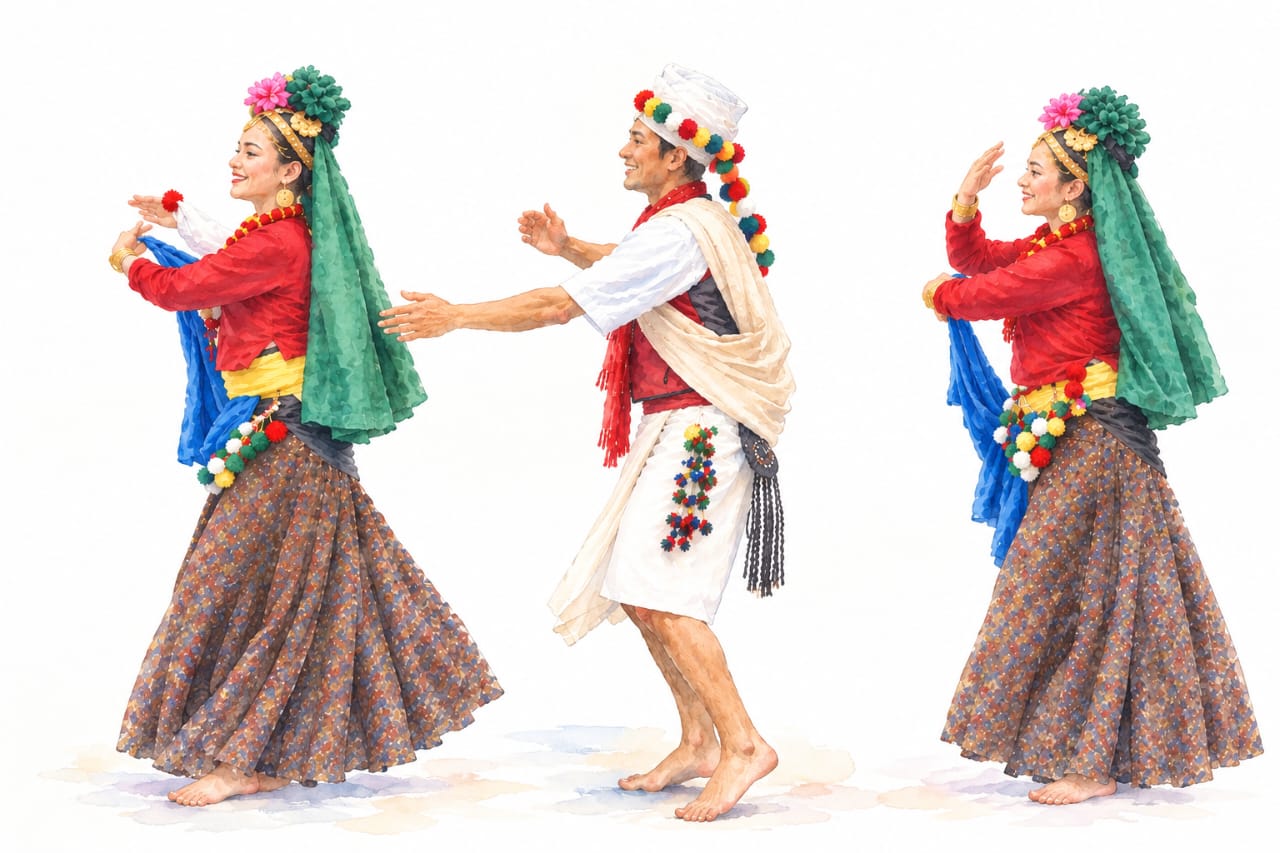
Sorathi is regarded as one of the grandest and most elaborate forms of the Maruni tradition. Presented in a narrative and theatrical style, it brings historical and social stories to life through the dialogue, movements, expressions, and dance of kings and queens. Rich in cultural symbolism, dramatic expression, and aesthetic appeal, Sorathi represents a highly refined form of Mangar folk performance.
A traditional Sorathi troupe generally consists of three Madales, one Purtunge, two Marunis, and a group of singers known as Ghode, who provide vocal accompaniment from behind the dancers. Depending on local customs, some performances may include two Purtunge’s and two Marunis. In certain places today, women themselves also perform the Maruni roles. Some regional traditions may additionally include a Lawarpandey, a comic character who adds humour and interaction to the performance.
The songs are traditionally led by the Gurumukhe or Gurubabu, who possesses detailed knowledge of the story, lyrics, rhythm, and overall flow of the performance. He is supported by the Garra Bhai, the accompanying singers who repeat and reinforce the verses, creating a collective musical dialogue.
Through its combination of storytelling, music, dance, costume, humour, and dramatic expression, Sorathi serves as a vibrant repository of Mangar oral tradition, collective memory, and cultural heritage.
Hurra (हुर्रा)
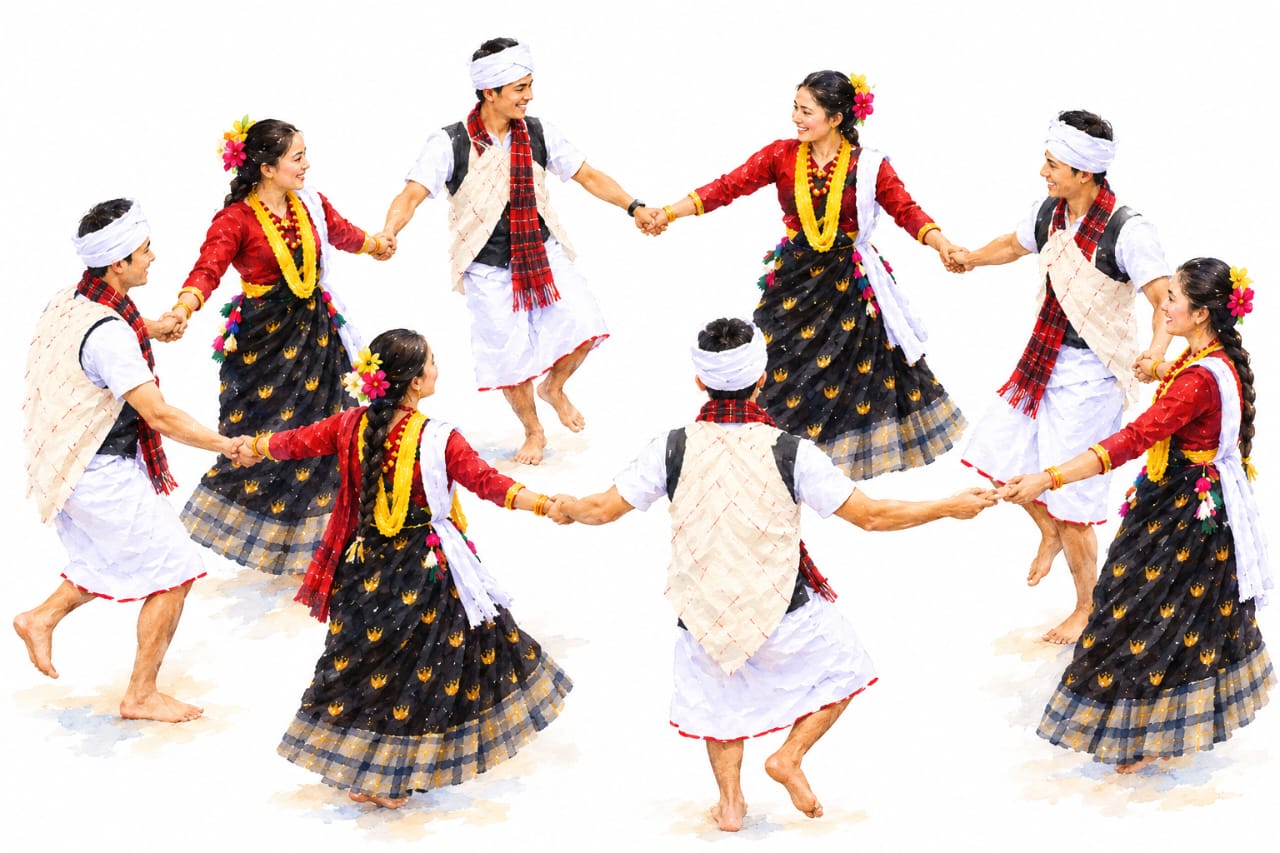
Hurra is a distinctive traditional dance of the Mangar community and holds a special place within the multicultural heritage of Sikkim. It reflects the community’s reverence for nature, remembrance of ancestors, agricultural life, seasonal cycles, and social solidarity.
Rooted in a traditionally agrarian way of life, Hurra expresses gratitude towards nature and ancestors while celebrating the rhythms of rural life. Its songs often evoke agricultural labour, seasonal changes, love for the land, and values inherited through ancestral traditions.
Hurra is fundamentally a community dance, welcoming people of different ages to participate. Men and women traditionally form a circle and dance together in gentle, coordinated movements to the rhythms of instruments such as the Madal, Jhyali, and Bansuri. The circular formation itself symbolises unity, cooperation, harmony, and mutual belonging.
The dance is commonly performed in open village courtyards, fields, community grounds, and fairs, where participation is more important than performance. Everyone is encouraged to join rather than remain merely a spectator. In this sense, Hurra serves not only as a form of recreation but also as a means of strengthening social bonds and collective identity.
In Sikkim, Hurra is particularly associated with agricultural and ancestral observances, including festivals such as Barahimijong, where the traditions of farming, nature worship, and ancestral remembrance come together.
Maruni (मारुनी)
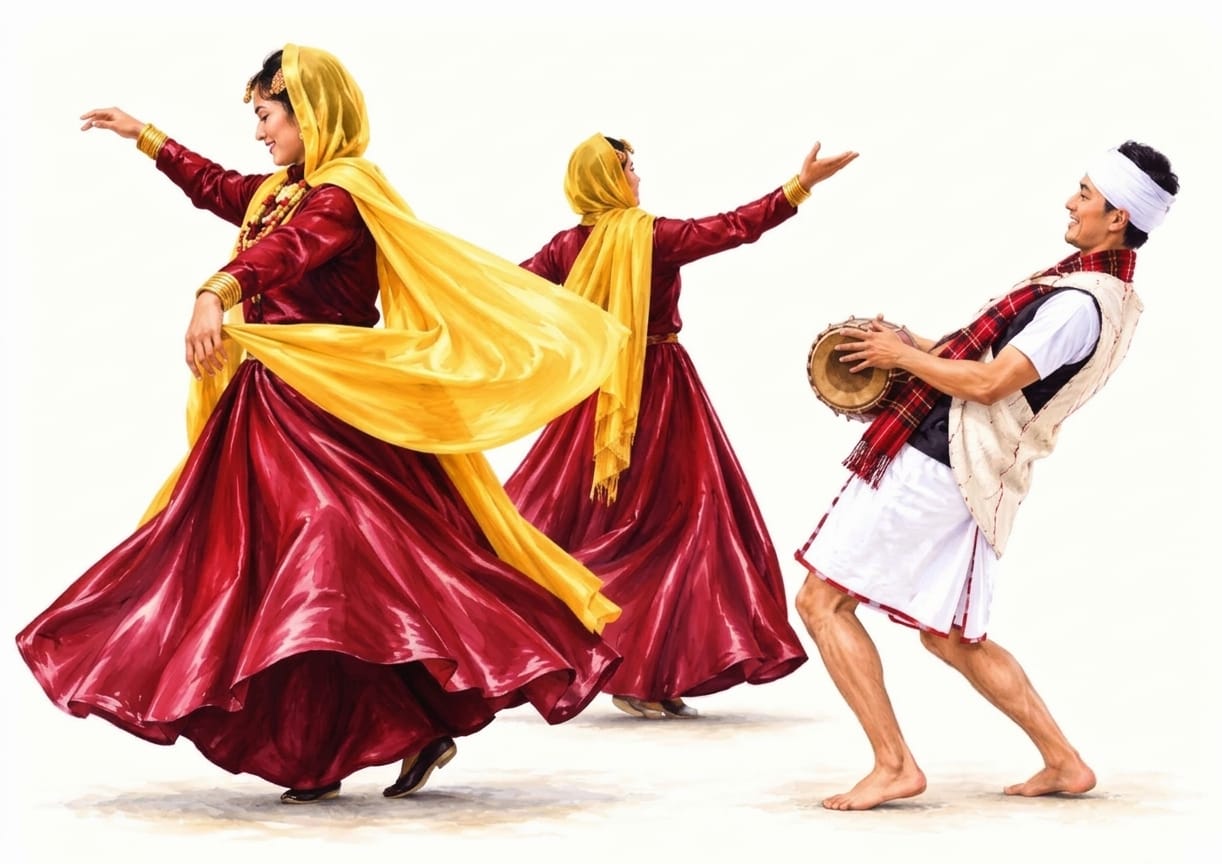
Maruni is one of the oldest and most celebrated traditional dances of the Mangar community and an important expression of its cultural identity. Traditionally performed during festivals, rituals, and community gatherings, the dance is distinguished by colourful costumes, traditional ornaments, rhythmic movements, and expressive singing.
One of its unique features is the portrayal of female characters by male dancers dressed in saris, blouses, and ornaments. Beyond its performative aspect, this transformation of identity carries a deeper symbolic meaning, reflecting the many roles, forms, and states through which human beings move in society. Thus, Maruni can be understood not merely as entertainment, but as an artistic reflection on identity, society, and human existence.
Although Maruni is now widely practised among Nepali-speaking communities across Sikkim, Darjeeling, Nepal, Bhutan, and parts of Northeast India, its traditional roots and ritual practices are closely associated with the Mangar community. Historically, it was performed in connection with ancestral worship, spiritual practices, religious observances, and traditional healing, before gradually becoming an important form of community entertainment.
A traditional Maruni performance is accompanied by two important characters, the Madale, the principal drummer and musical guide, and the Dhatuware/Purtunge, who acts as the protector, comic performer, and social commentator. The Madale is responsible for maintaining the rhythm, melody, songs, and ritual sequence, while the Dhatuware adds humour, satire, and interaction with the audience.
The performance traditionally begins with a ceremonial preparation. The Maruni costume and ornaments are arranged on a nanglo along with flowers and ritual offerings such as rice, akshata, and a sacred vessel. They are worshipped before being worn by the performer. The paired madals are likewise ritually honoured and decorated. A decorated bamboo or ceremonial pole, known as linga, is then erected in the courtyard, marking the auspicious beginning of the dance.
Jhamre (झाम्रे)
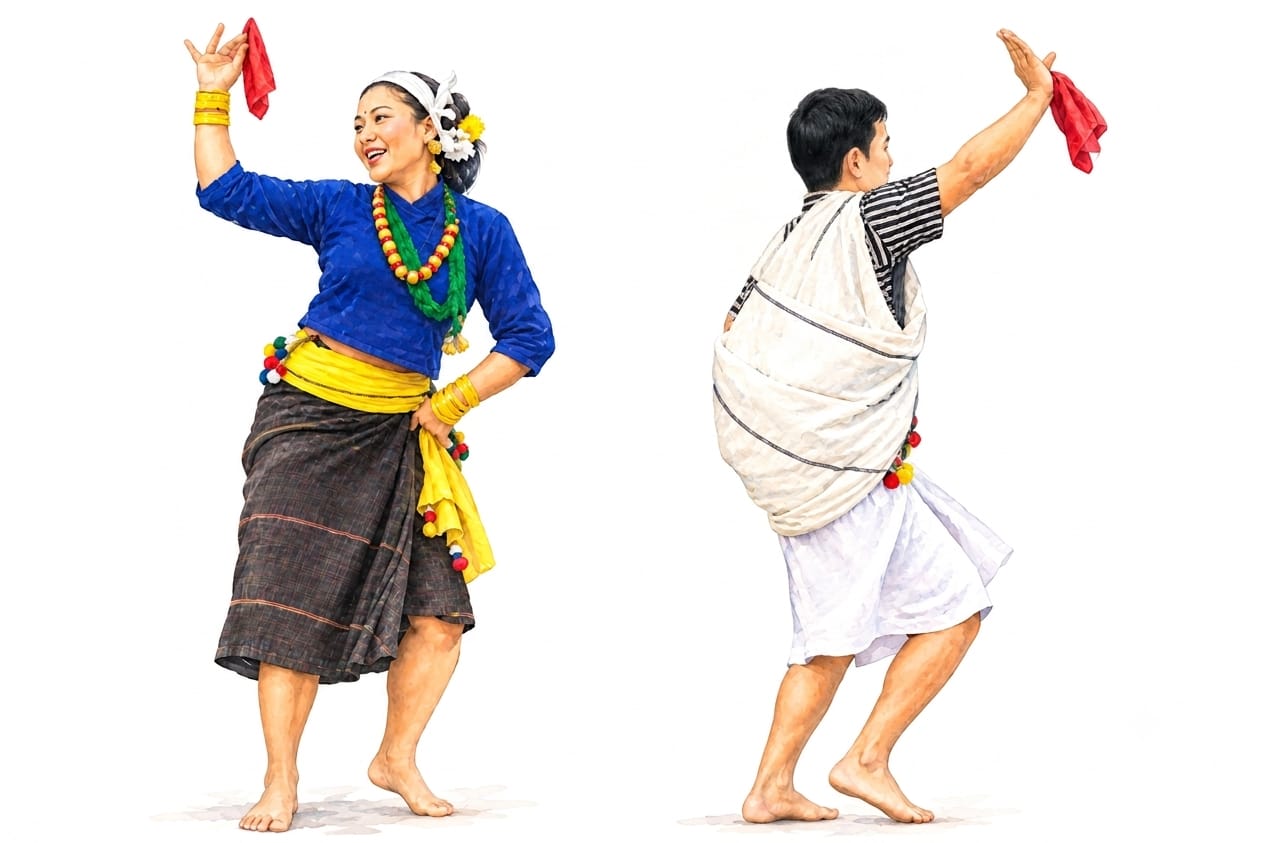
Jhamre is a vibrant and expressive musical and dance tradition of the Mangar community. The term Jhamre is generally believed to have evolved from Jhyawre, which in turn is associated with the word Jhyauro. In Mangar oral usage, it is also known as Jhabarya, while Jhamre and Jhyawre are sometimes used interchangeably. Despite some interpretations linking the name to a monotonous or wearisome style of singing, Jhamre is, in practice, lively, energetic, and deeply rhythmic.
Jhamre songs are particularly associated with love, affection, longing, and separation. They are performed to the vigorous rhythms of the khaijadi and Madal, accompanied by spirited dancing. The dance often involves rhythmic changes and characteristic rising-and-sitting movements, popularly expressed through the lively Jhyam-Jhyamti style.
Unlike many ritual or festival-specific traditions, Jhamre does not require a particular occasion. It is sung throughout the year, either individually or collectively, and has traditionally accompanied everyday activities such as gathering grass and firewood, working in the fields, and visiting water sources. It therefore forms an intimate part of the everyday social and emotional life of the Mangar community.
Jhamre also embraces a wide range of Nepali folk forms, including Kheli, Chudka, Sangini, Asare, Sorathi, and Lahari. These forms are woven into Jhamre’s folk metres and provide a rich space for expressing human emotions, experiences, relationships, and rural life.
Source: Dr. Rakcha Rana